
Updated in October 2025
Introduction
If you’re wondering how much is a putting green in a garden, here’s a clear, direct answer: in the UK in 2025, a professionally installed garden putting green typically costs £90–£160 per m², depending on size, sub-base, edging, number of holes and access. A modest 20–30m² green might cost £2,500–£5,000, while a larger 50–60m² setup with fringe and chipping zones can run £6,000–£10,000+. DIY materials alone may cost £25–£35/m² (before base work and labour).
The good news for all golf fans is Look Real Lawns can provide mini putting greens starting at just a few hundred pound!
Below is a full guide to understanding all the costs, steps, benefits, pitfalls and trends – so you can plan your own garden putting green with confidence.
Table of contents
1. What is a garden putting green?
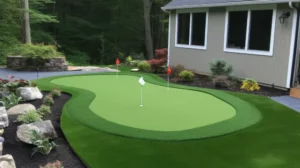
A garden putting green is a dedicated area in your garden designed for practicing golf putting (and often chipping) with a smooth, controlled surface that mimics the feel of a golf course green.
It differs from ordinary artificial grass in that:
The surface is very fine, low pile, and even, to allow consistent ball roll.
It often includes cups/holes, flags, and sometimes a fringe or chipping zone (a slightly longer grass surrounding the green).
The base beneath is more precise—good drainage and compaction are essential to prevent dips or unevenness.
The Stimp speed (a measure of how fast a ball rolls) is more critical—to replicate realistic putting speeds.
2. How to install a putting green: step-by-step
Here’s how a professional installer (or experienced DIYer) typically builds a garden putting green:
Step 1: Survey & design
Measure the area.
Choose shape, number of holes and fringe layout.
Check site access (can digger/wheelbarrow reach?).
Assess drainage and slope (ideal: gentle fall away from house).
Step 2: Excavation & removal
Remove existing turf/soil to desired depth (often 100–200 mm depending on sub-base).
Grade to fall toward drainage points.
Step 3: Sub-base & drainage
Lay a compatible aggregate (e.g. MOT Type 1, crushed stone).
Install geotextile membrane to separate soil.
Compact in layers with plate compactor.
Add drainage pipes or gravel trenches if site demands.
Step 4: Fine screed or bedding layer
A final “fines” layer (e.g. kiln-dried sand or screenings) is smoothed to true surface tolerances (± a few mm).
Use straight edges and string lines.
Step 5: Lay putting turf
Roll out putting surface, cut to shape.
Butt seams carefully to minimise ridges.
Lay fringe or surroundings turf if applicable.
Step 6: Cut cups & holes, install flags
Precisely cut hole circles.
Insert cup sleeves and flags to exact levels flush with surface.
Step 7: Infill & brushing
Add fine sand or infill (if product requires) to stabilise turf and help ball roll.
Brush the surface to work infill and settle fibres.
Step 8: Final checks & roll
Use a roller (light) to bed surface.
Test several putts to check flatness, consistency, break.
Adjust minor low spots with infill or lifting/relaying small patches.
Step 9: Clean up & aftercare prep
Remove waste, tidy edges, install edging restraints.
Provide owner with care instructions.
This process ensures a stable, flat, fast, and durable putting green.
3. Cost of a garden putting green in the UK (2025)
Here are current benchmark figures and project totals, including labour and materials. Use these for planning, not exact quotes.
| Scenario | Area | Typical installed cost (per m²) | Approx total cost |
|---|---|---|---|
| Modest home green | 20 m² | £90–£120/m² | £1,800–£2,400 |
| Better spec / nicer finish | 30 m² | £110–£140/m² | £3,300–£4,200 |
| Larger, with fringe & complexity | 50 m² | £130–£160/m² | £6,500–£8,000 |
| Premium / large estate-style | 60 m²+ | £140–£180/m² | £8,400+ |
These costs include excavation, sub-base, turf, cups, edging, infill, labour, and waste disposal.
To cross-check: Checkatrade’s guide mentions ~£100/m² for an “average size green” including holes, flags, levelling. Checkatrade
Also, some artificial grass installers suggest “£70–£80/m² plus VAT” for putting-green installation (for simpler builds). CLS Scotland
Key insight: The per-m² rate often declines slightly for larger areas, but complexity (shape, access, slope) can push costs higher.
4. What factors affect the cost?
Understanding what moves the price helps you budget smartly. Here are the main cost drivers:
Size & shape
More area = more base, more turf, more holes. Complex shapes increase waste and cutting labour.Sub-base depth & soil condition
Poor soils, heavy clay, or sloping sites need deeper base or extra drainage, adding cost.Access & terrain
Tight gardens or steep steps make transporting materials harder—more manual labour.Edge restraint & edging materials
Concrete kerbs, steel edging or timber framing add to costs.Number of holes, fringe, chipping zone
Extra cups, flags, and extra turf around the main green increase cost.Quality of turf & Stimp rating
High-spec turf (densities, UV stability, fibre type) costs more but gives better play.Infill, brushing and seam work
Good infill and seam work improve durability; corners and curves cost more to finesse.Waste removal & site cleanup
Carting off spoil or old turf adds to the bill.Local labour rates & region
In the South East, labour tends to be pricier than rural areas.Warranty, guarantees, aftercare
Some installers include maintenance and longer warranties as part of the package.
5. Benefits of having a putting green at home
Here are 10 key benefits of installing a garden putting green:
Daily practice convenience – no travel to the course.
Improves your short game and reduces strokes.
Adds a unique and premium garden feature.
Low maintenance compared to grass green (no mowing, watering).
Year-round usability (weather resistant).
Great entertainment / social space.
Increases usability of garden corners or awkward spaces.
Potentially enhances lifestyle appeal for golf lovers.
Encourages family/friends to try golf.
Customisable shape, holes, slope to your preference.
Here’s the thing: while not everyone will recoup the cost at resale, for a golf lover the satisfaction and usage often justify the investment.
6. Top tips & mistakes to avoid
You might be wondering: what traps should I watch out for? Here are tips and pitfalls:
Tip 1: Insist on proper base compaction – cheap base = bumps later.
Tip 2: Choose turf with good Stimp characteristics for realistic roll.
Tip 3: Use edge restraints to prevent lifting or turf creep.
Tip 4: Plan access carefully (wheelbarrows, machinery).
Tip 5: Include a fringe or chipping zone to practice varied shots.
Tip 6: Opt for seams laid away from principal putting lines.
Tip 7: Ensure adequate drainage – ponding ruins surfaces.
Tip 8: Don’t skimp on infill – gives stability and roll consistency.
Tip 9: Check warranties and aftercare with your installer.
Tip 10: Test ball roll in different weather conditions before final sign-off.
Mistakes to avoid: Using cheap non-putting turf, shallow base, poor seams, forgetting drainage, or overestimating DIY skill.
7. Best way to decide: DIY vs professional
Here’s a breakdown comparing DIY and Professional:
| Feature | DIY | Professional |
|---|---|---|
| Cost | Lower labour cost, but risk of mistakes | Higher upfront but reliable finish |
| Time & effort | Intensive, needs time, tools, skill | Quicker, less hassle |
| Quality & precision | More risk of unevenness, seam issues | Better compaction, seams, drainage |
| Warranty & guarantee | Often none | Often includes workmanship warranty |
| Tools needed | Plate compactor, screed bars, rollers | Already provided by contractor |
| Risk | Mistakes, uneven speed, repairs | Lower risk, backed by contract |
If you’re confident with landscaping and precision work, DIY is possible for small greens. But for high playability, a pro installer like Look Real Lawns ensures quality, warranties and peace of mind.
8. Timeframes & maintenance
Time to install:
A modest green (20–30 m²) may take 2–4 days (excavation, base, turf, finishing).
Larger or more complex shapes may take 4–7+ days.
Weather and curing time can add buffer days.
Maintenance checklist:
Weekly: Remove leaves/debris, brush surface.
Monthly: Inspect seams, check infill levels, touch up low spots.
Bi-annually / annually: Deep brush, top up infill if needed, wash surface.
Occasionally: Weed barrier check; edge fix if turf creep.
Annual time commitment is usually modest (1–3 hours), compared with mowing and watering a grass surface.
In some wet seasons, draining and drying may slow use – so slope and drainage are critical.
9. Case study / worked example in the South East
Here’s a worked example from a hypothetical project in Kent / Surrey:
Client brief:
Garden in Sevenoaks, Kent.
Space: 30 m² green + 8 m² fringe.
Moderate access: one gate, wheelbarrow access only.
Slight slope, clay soil requiring good base.
Estimated costs:
| Item | Cost |
|---|---|
| Excavation & soil removal | £800 |
| Sub-base & drainage | £1,800 |
| Fine screed / bedding | £500 |
| Putting turf (30 m²) | 30 × £120 = £3,600 |
| Fringe turf (8 m²) | 8 × £90 = £720 |
| Cups, flags, edging | £350 |
| Infill, brushing, seams | £300 |
| Waste removal, finishing | £300 |
| Labour & overhead | £1,200 |
| Estimated total | £9,570 |
This yields an average ~£9,570 / 38 m² = ~£252/m² (reflecting challenging access and premium finishes). A simpler site might deliver below £150/m².
In practice, a skilled installer like Look Real Lawns might refine that price based on your site, negotiate waste removal, or use better access to cut costs.
10. Emerging trends for 2025 and beyond
Here are some trends shaping putting green installations in 2025:
Permeable / SUDS-friendly base systems: Installers increasingly favour systems that conform to Sustainable Drainage Systems rules, allowing better water soakaway.
Recycled infill & eco-friendly materials: More use of recycled sand, nylon fibres, and greener backing systems.
Smart monitoring & sensors: Soil moisture sensors or sensors embedded under turf to monitor compaction/drying.
Modular / interchangeable fringe systems: You might be able to swap in faster/slower fringe strips for practice variety.
Hybrid “natural + synthetic” fringes: Blending short natural grass on slopes with synthetic greens to reduce heat and enhance aesthetics.
Faster roll / higher Stimp turfs: As fibre and production tech advance, home turfs may reach more consistent pro-green speeds.
If you want, I can future-proof your quote to account for these innovations.
11. FAQs
Q: How much is a small garden putting green?
A: A small 20 m² green typically costs £1,800–£3,000 installed (depending on base, turf quality, access).
Q: Do I need planning permission?
A: Usually not, as this is landscaping. But if you alter levels near boundaries or block drainage, always check Planning Portal (gov.uk) or your local authority.
Q: Can I build it myself?
A: Yes – if you are comfortable with precision base work, drainage, and turf laying. But poor execution often leads to uneven roll or problems later.
Q: How long will it last?
A: With decent turf and care, a putting green can last 10–15 years. Turf warranties often cover 8–10 years.
Q: Will a putting green add value to my home?
A: It may appeal to golf enthusiasts, but it’s niche. Value uplift isn’t guaranteed. The main benefit is lifestyle use.
Q: What if my garden is very sloped or has poor drainage?
A: You’ll need deeper base, perhaps retaining or terracing, and more drainage work. That can significantly raise cost—but a good installer should plan for it.
Conclusion & Next Steps
So: how much is a putting green in a garden? In 2025, expect £90–£160/m² installed or a few thousand pounds for modest builds, and much more for premium features or tricky sites. DIY is possible but risky.
Get in touch with us today for a free quote to design your dream putting green in your own garden!